Every one of these opens the model already filled in with realistic numbers
for its kind of building: a rent roll, allowances, a capital plan, a reassessment and a loan,
at 123 Main Street. Type your own deal over it and the whole thing re-runs. Nothing is saved
to a server until you save it.
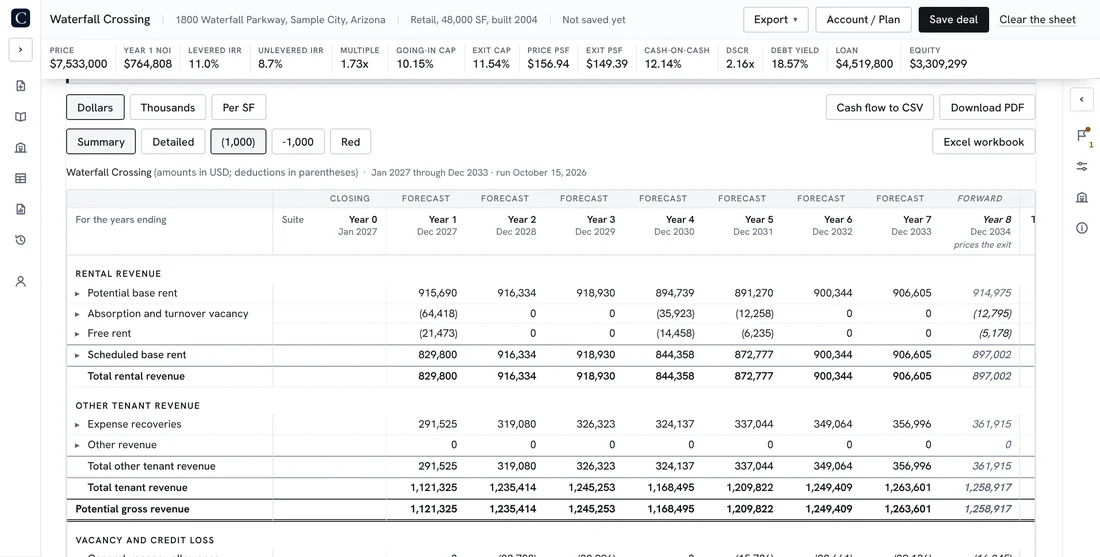
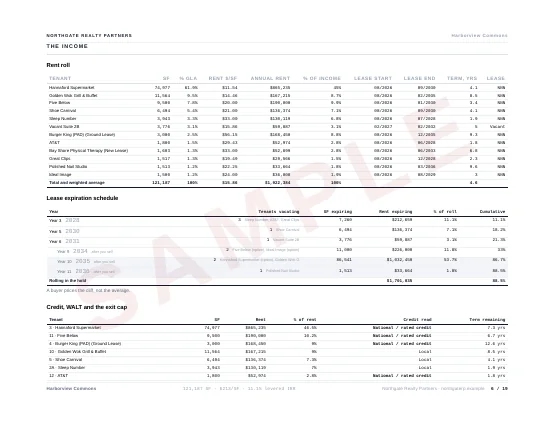
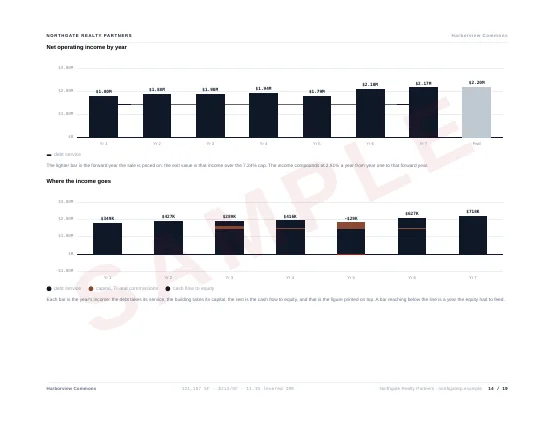
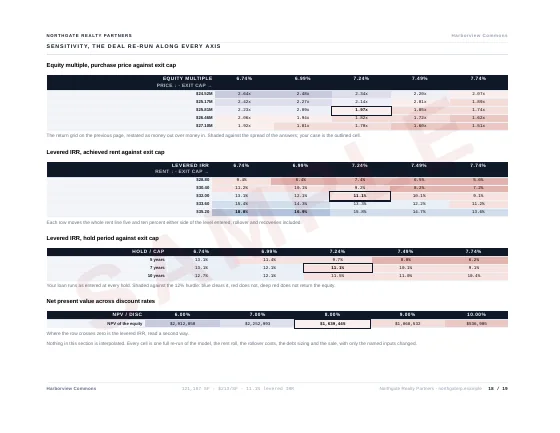
27,000 SF Texas strip center, 15 tenants, fully worked
A finished underwrite to read before you run your own: a Round Rock strip center
with national credit beside local operators, a real rent roll with lease dates and
escalations, debt sized and priced, and a five-year hold underwriting to a
12.4% levered IRR and 1.71x. Open it and every assumption is standing where the
engine left it; change anything and it re-runs. The Excel workbook and the report
samples on this page are printed from this exact deal.
Open the sample deal →
Two one-beds, four two-beds, a coin laundry, a bank loan at 75%
The first building most people buy, set up the way a small-town six-unit actually
runs: rents of $1,150 and $1,425 a month, the owner paying water, sewer and the common
electric, taxes and insurance per unit, a third-party manager at 6%, a 30-year bank loan
at 75% of price. Turnover is priced at the make-ready and the three weeks the unit
sits empty. Type your rents, your taxes and your price over these and the return, the
coverage and the cash flow re-run as you go.
Entry cap 6.79% · stabilized DSCR 1.36x ·
levered IRR 10.2%
Open it in the model now →
13,000 SF dark drugstore, demised into three suites
The pharmacy chains have left thousands of these behind. The boxes run
7,000 to 14,000 square feet, and the users taking them are discount retail, medical
and thrift rather than another pharmacy. This template demises the box into a
discount variety anchor, an urgent care clinic and an end-cap coffee unit, with the
demising cost, the landlord work and a second-generation allowance on each suite.
The number to watch is the development spread: yield on cost against your exit cap.
Yield on cost 8.95% · exit cap 7.50% ·
spread +128 bps · levered IRR 9.2%
Open it in the model now →
25,275 SF, two credit pads, nine shops, one dark restaurant
A stabilized center with two credit pads carrying the income and nine shops
carrying the risk. The pad rents and lease structure follow a 2025 Brevard County
trade: a fast casual restaurant at 2,350 SF and a national bank branch at 3,425 SF,
both on fifteen-year corporate leases with 10% increases every five years. One 2,400 SF former restaurant is dark
and carries a real second-generation restaurant allowance at $45 a foot, four months
free and a 6% commission. So you can see what one vacancy actually costs.
Entry cap 6.30% · stabilized DSCR 1.37x ·
levered IRR 9.6%
Open it in the model now →
71,587 SF, 48,387 SF supermarket plus shops and two pads
The anchor pays $10.50 a foot against shop rents of $24 to $55, which is the
whole point of the format: the supermarket buys the traffic and the shops pay for
it. The anchor lease runs twenty years with percentage rent at 1% over a natural
breakpoint, so the overage turns on once sales clear base rent divided by the rate.
Anchors typically sit at 50 to 70% of the gross leasable area; here it is 68%.
Entry cap 6.48% · blended rent $18.45/SF ·
stabilized DSCR 1.47x · levered IRR 8.6%
Open it in the model now →
12,000 SF of retail below, 26 apartments above
Two income streams that a buyer will price at two different rates. The shops run
on a rent roll and per-foot recoveries; the apartments run on a unit mix, turnover and
per-unit expenses. The exit prices the retail at 7% and the residential at 5.5%,
because averaging the two and applying one cap rate to the total is how mixed use
gets mispriced. One loan sits across both.
Blended entry cap 6.77% · two exit caps
7.00% / 5.50% · levered IRR 12.8%
Open it in the model now →
Market and restricted units, turnover and a full operating statement
Four unit types on their own lines, because restricted units grow at 1.5% and turn
over at 18% while the market units grow at 3.5% and turn over at 55%, blending
them overstates both the income and the churn. Turnover is priced properly: the
make-ready, the leasing fee and the twenty-one days the unit sits empty. Expenses run
per unit per year, the way an apartment P&L is actually kept.
Entry cap 5.99% · stabilized DSCR 1.40x ·
levered IRR 10.1%
Open it in the model now →
Raw land, a build-to-suit pad and a four-suite shop building
Buy the land, put buildings on it, lease them and sell. A coffee pad on a
fifteen-year corporate lease at $568 a foot to build, and a speculative 6,400 SF
shop block at $250 a foot that carries its own leasing risk. Construction, the
allowance and the commission all sit in the basis, so yield on cost is measured
against what the project actually costs rather than against the land you started
with. Nothing earns until it opens.
Yield on cost 7.86% · exit cap 6.75% ·
spread +111 bps · levered IRR 9.4%
Open it in the model now →
53,488 SF, renovated 2024, two vacant shops to lease up
A thrift superstore holds 48% of the area on a fifteen-year lease with 10% steps,
a private academy holds another 34%, and six small shops carry the rest. Two suites
sit vacant, and their lease-up is the growth story. The anchor concentration is
exactly the kind of thing the deal flags call out, and the model prices the
re-letting risk instead of hoping.
Entry cap 6.20% · stabilized DSCR 1.50x ·
levered IRR 8.0%
Open it in the model now →
27,019 SF, suite numbers and all, marketed at a six cap
Fifteen small tenants, none over 15% of the income, every suite let, and an EV
charging license on the side. The catch is the lease terms: one to seven years, so
most of the roll turns over inside the hold and the renewal assumptions do the
heavy lifting. The template prices the ask against that roll as it stands, which is why
the answer is lower than the brochure’s cap rate implies.
Entry cap 6.89% · most of the roll expires inside the hold ·
levered IRR 13.8%
Open it in the model now →
2,206 SF near a university, bought empty, one lease to sign
The smallest check on this page: one storefront on a college high street, bought
vacant, eight months to a signed coffee tenant at $58 a foot with four months free
and a real allowance. One lease is the whole deal, so the downtime, the TI and the
exit cap do all the work. A clean way to see how the model treats lease-up risk.
Yield on cost 6.34% · exit cap 5.50% ·
levered IRR 10.2%
Open it in the model now →
44 units, five lines of unit mix, a renovation program and Local Law 11
A Manhattan walk-to-the-subway building: market studios through penthouses on one
set of assumptions, eight rent-stabilised units on another, growing slower and
almost never turning over. Six one-beds renovate for a $450 premium, the facade
cycle and the elevator are in the capital plan, and the buy is priced against a
tighter exit. Unit numbers ride along on every line.
Entry cap 5.20% · stabilized DSCR 1.55x ·
levered IRR 8.4%
Open it in the model now →
13,225 SF corporate pharmacy, and you own the dirt, not the building
A ground lease pays rent with no expenses against it, so every dollar is margin
and the whole deal is the lease term. The pharmacy pays $11.91 a foot with a step
coming, and the play is the negotiation in year four: a $100,000 credit buys a fresh
twenty-year term, and the exit prices off that term rather than the short one you
bought. The model carries the credit as a cash item in the year it lands, so the
trade is priced, not assumed.
Entry cap 5.16% · exit 5.00% on the fresh term ·
five-year hold · levered IRR 4.9%
Open it in the model now →
Shops below, offices above, on land that belongs to someone else
The other side of a ground lease: here you are the tenant, and $153,600 of ground
rent comes off the top of the cash flow every year before anyone else is paid. That
is why the deal trades around two hundred basis points over the fee deals on this
page. The office floors re-tenant on real money, $45 a foot of allowance, and the
model shows how much of the headline spread the ground rent and the retenanting
quietly hand back over a ten-year hold.
Entry cap 8.30% · exit 8.00% after ten years ·
levered IRR 11.8% · 1.71x
Open it in the model now →